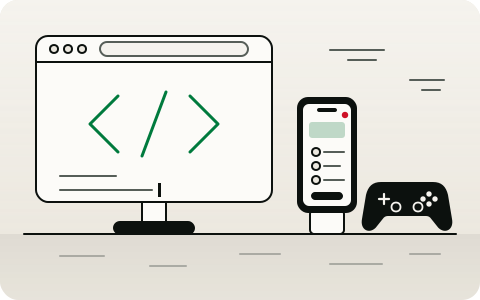
Each work topic speaks to a different kind of user and a different operating model. Below is what we look at in each of them.
Classified-ad and digital marketplace software
On platforms that bring buyers and sellers, businesses and customers together, we consider the listing flow, search, messaging and the listing owner's management screen as a whole. How local businesses will join the system is another topic we evaluate.
Listing management
Search and filtering
Messaging
Enterprise software and automation
We look at turning a business's daily work, from orders to reporting, into screens and automatic flows. How it will connect to the tools already in use and how the team will get used to the new routine are part of the work.
Workflows
Reporting
System connections
Game and software development work
In games and software products we focus on how an idea becomes a playable or usable first version, on the target audience, and on how the product will be kept alive through later releases.
Prototype
Target audience
Release plan
These topics are not separate islands: behind a classified-ad platform there is often an automation, and behind a game there is an orderly data structure.
Layers
A product is made of connected layers
When we evaluate a software project we look at the whole product, not only at the screen. From what the user sees to the place where data is kept, we ask whether every layer has someone responsible for it and an operating plan.
Interface
The layer visitors see and touch: web pages, mobile screens, forms and lists. Readability, language options and right-to-left writing are handled here.
Application
The layer where business rules run. How tasks such as registration, search, ordering or matching proceed is defined here.
Data
The layer where records, listings and user information are kept in order. Who may access what, and how the data is protected, is dealt with here.
Automation
The layer where recurring tasks run by themselves: notifications, reports, approval flows and transfers between systems.
When a layer is left out of the picture, the product may not do the job expected of it in the field, so we discuss all of them together.
Which questions we look at
Before a software idea becomes an investment, we look for answers to these questions.
These questions are not asked in the same order in every project; depending on the nature of the work, some come to the front and others come later.
What need does the product solve, and who will use it?
From which devices, in which languages and under what connection conditions will users reach the product?
Where will the data be kept, who will be able to access it, and how will personal information be handled?
How will the product connect to existing tools and to payment and accounting systems?
Who will run the product, and how will maintenance, updates and user support work?
Which permit and approval processes are involved, and which institutions need to be consulted?
How will the structure grow if the product grows or the needs change?
How we work
For every new project we first examine the need, the investment conditions and the operating model. Depending on the nature of the work, we meet with investors, producers and local businesses.
At the end of each step what emerges is not a decision but an assessment to be discussed together.
Need
We look at whose problem the product will solve and how the job is done today.
Investment conditions
We evaluate the scope, the resources required, and the permit and infrastructure conditions.
Operating model
We clarify who will run the product, how it will be sustained and how maintenance will work.
Meetings
We listen to the expectations of those who will use and support the product, and we discuss whether the technical side can be carried out.
Joint review
We go over the findings together and talk about the stages through which the product could proceed.
Technology and software
Related fields
Software can carry the digital side of many fields. These are the topics that work most closely with this field.
Technical training and simulation software for the defence industry are among the topics where software meets training and test environments.
Frequently asked questions
Which kinds of software projects do you look at?
We look at web and mobile applications, classified-ad and digital marketplace platforms, enterprise software and automation, and game development work. Each project is first evaluated for its need and its operating model.
How do you evaluate a software idea?
We look at the need the idea solves, the user, the resources required and how the product will be run. Depending on the nature of the work, the evaluation continues with meetings with investors, producers and local businesses.
What should I share when I get in touch?
It is enough to describe briefly what the product does, who it is for and what stage it is at. You may also write the location and scope of the project and the kind of partnership you are looking for.
How does software relate to the other fields of activity?
Software can support projects in other fields, such as digital tools in education, marketplace platforms in trade, and automation and energy monitoring in industry.
How are the language and device options of a product decided?
That depends on the project. Language options such as Turkish, Arabic and English, right-to-left writing and different device types are all among the questions we study.
Let us evaluate your idea together
To help us evaluate your investment, supply or joint-project proposals, you may share the location and scope of the project and the kind of partnership you are looking for.