Water, production and operations are parts of the same flow. In farming investments we first study the site and the water, then consider together how production and operations can be set up.
Our work moves along the topics below. Both look for an answer to the same question: how could the planned farming investment be run at that site and beside that water?
Site survey for trout farming in the Euphrates basin
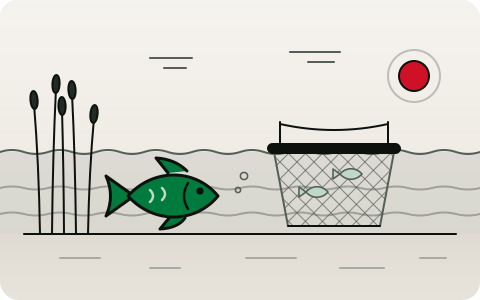
Where a farm is built is one of the decisive choices of a project. We look at areas in the basin that may suit trout farming, studying the water source, the flow, the lie of the land and the access routes. A site survey helps to clarify what is known before an investment decision.
Water source
Lie of the land
Access
Review of water, production and operating conditions
Water, production and operations cannot be thought of apart. We consider together the state of the water, the set-up in which production could be organised and what the day-to-day running of the facility needs. The aim is that the investor sees the whole picture before deciding.
Water conditions
Production set-up
Operating needs
Site steps
The site survey, step by step
A site survey generally follows this order. The content changes from project to project; the aim is to read the site and the water together.
Location
We look at where the site is, how close it lies to roads and the surrounding infrastructure, and what the access and transport conditions are.
Water conditions
The source, flow, temperature and cleanliness of the water are observed on site, and we consider how seasonal change might affect production.
Production model
We assess whether a pond, a cage or another rearing set-up suits the site and the water.
Operations
It is clarified who will run the facility, with which needs and through which partnerships.
Assessment
Which questions we look at
When we assess a farming project these questions come up. The answers become clearer step by step, together with the investor.
Location and access
Does the site suit farming, and how will the facility and the product be reached?
Water and infrastructure
Can the water source and its flow carry production, and how will roads, power and water be connected to the site?
Permits and approvals
Which permit and approval steps will the project go through, and how will they be handled?
Operating model
How will the facility be run, and how will responsibilities and needs be shared between the parties?
Partners
Which investors, producers and local businesses need to work together?
Demand and distribution
In general terms, what do demand for the product and its route to the market look like?
Risks
What risks lie in the water, the site and the operation, and what measures could be considered against them?
Our approach
How we work
For every new project we first examine the need, the investment conditions and the operating model. Depending on the nature of the work, we meet with investors, producers and local businesses.
The need
We understand which need the investment answers and what is meant to be built on site.
Investment conditions
We examine how far the land, the water and the infrastructure suit the investment.
Operating model
We clarify how the facility will be run and how responsibilities will be shared.
Meetings
Depending on the nature of the work, we work out which parties need to be at the table and meet with them.
Joint review
We share what has been gathered and decide on the next step together.
Related fields
Related fields
Agriculture and aquaculture does not stand alone: production, the destination of the product and infrastructure meet other fields of activity.
Food, restaurants and catering
What is farmed can be thought of as a raw material in the food field, and it is considered together with restaurant, retail and catering work.
One of our work topics is a site survey for trout farming in the Euphrates basin. We are also open to assessing other farming proposals that study water, production and operating conditions together.
What does a site survey cover?
It deals with the location, the water conditions, the production model and the operating set-up. The content changes with the project; the aim is to read the site and the water together before an investment decision.
What is useful to share when getting in touch?
You can share the location and scope of the project and the kind of partnership you are looking for. If you have information on the water source, the land or operations, adding it makes the assessment easier.
Which parties are met for a project?
Depending on the nature of the work, we meet with investors, producers and local businesses. Which parties are needed depends on the needs of the project and its operating model.
How does this field connect with the other fields of activity?
What is farmed can be a raw material for the food field, a product reaching the market concerns trade and logistics, and water infrastructure meets construction and infrastructure work.
Partnership and contact
To help us evaluate your investment, supply or joint-project proposals, you may share the location and scope of the project and the kind of partnership you are looking for.